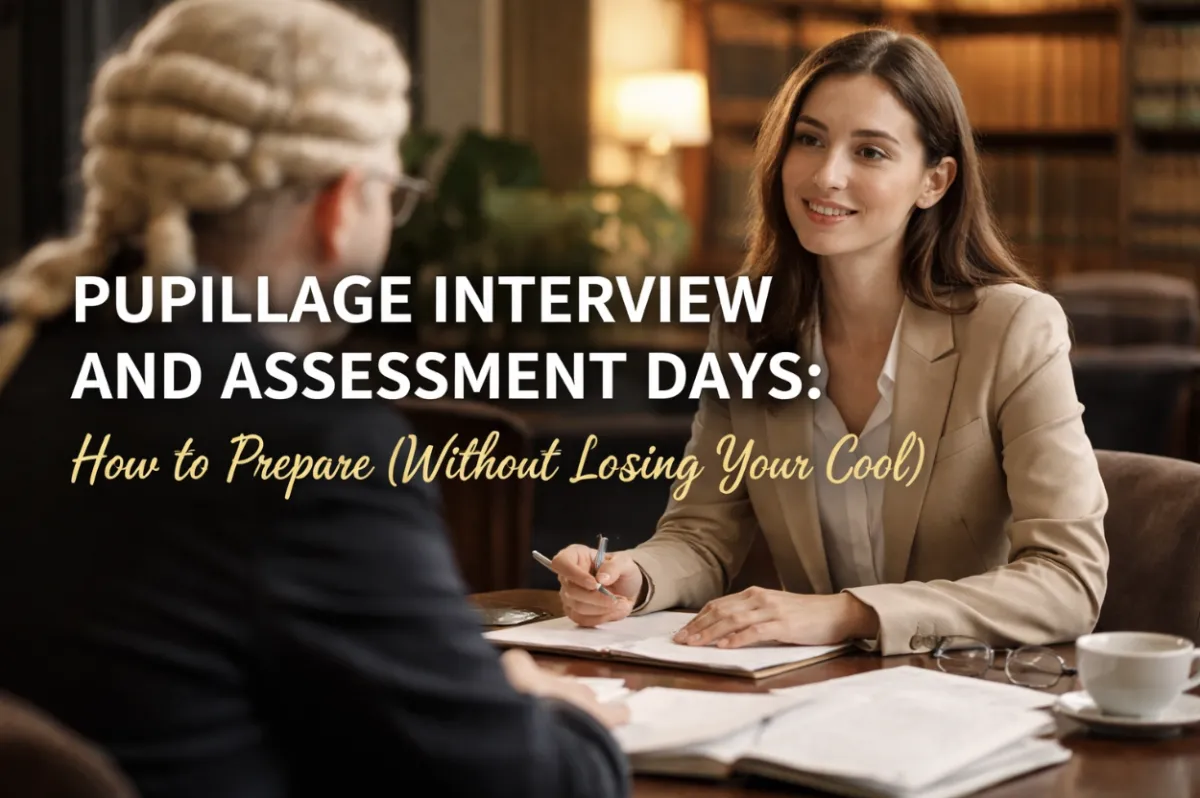
Pupillage Interview and Assessment Days: How to Prepare (Without Losing Your Cool)
The pupillage interview isn't about being perfect. It's about showing you can think on your feet, argue persuasively, and handle pressure without crumbling into a pile of legal textbooks.
Let's be honest. The words "pupillage interview" are enough to send a shiver down any aspiring barrister's spine. You've spent years grinding through university, perfecting your legal knowledge, and dreaming of that wig and gown. Now it all comes down to a 25-minute interview and an assessment day that feels like the legal equivalent of The Hunger Games.
But here's the thing: it doesn't have to be terrifying.
With the right preparation: and a healthy dose of perspective: you can walk into that interview room feeling confident, composed, and ready to show chambers exactly why they need you. Let's break it down.
What Actually Happens at Pupillage Interviews and Assessment Days
Before you can prepare, you need to know what you're preparing for.
First-round interviews typically last 20-25 minutes. You'll face a panel of around three people, and the format is usually standardised. Some chambers include a short advocacy exercise: like a bail application or plea in mitigation: that you'll receive 20-30 minutes before your interview slot. Sometimes, it may also be a non-legal piece of advocacy.
After that? General questions about your practice area, ethical dilemmas, and why you want to join that particular chambers.
Second-round interviews are more in depth. You may face more probing questions about your experience, motivations, and ability to handle the realities of life at the Bar.
Assessment days can combine multiple elements: group exercises, written tasks, presentations, and individual interviews. They're designed to test how you perform under sustained pressure: not just in one moment, but across several hours.
The good news? Every single one of these skills can be practised. And that's where preparation becomes your secret weapon.
Start With the Basics: Research, Research, Research
This sounds obvious, but you'd be surprised how many candidates skip this step.
Know your chambers inside out. What areas of law do they practise? Who are their notable members? What recent cases have they been involved in? More importantly, how does their work connect to your interests and experience?
Re-read your application. The panel will base many of their questions on your Pupillage Gateway application, CV, or covering letter. If you mentioned a particular case, be ready to discuss it in depth. If you claimed to have "excellent advocacy skills," be prepared to prove it.
Stay current on legal news. Topical questions are common. Know what's happening in the courts, what legislation is being debated, and what the big ethical conversations are in your practice area.
Pro tip: Create a pupillage notebook. Compile all your preparation notes, key cases, and practice answers in one place. It makes revision so much easier when interview season hits.
Why Mooting Is Great Interview Prep
Here's something chambers won't always tell you directly: they're looking for people who can do the job, not just talk about it.
That's where mooting comes in.
A mooting competition forces you to construct legal arguments under pressure, present them persuasively, and respond to tough questions from judges: exactly what you'll face in a pupillage interview. It's the closest thing to a real courtroom experience you can get as a student.
At Speed Mooting, we've built our entire platform around this idea. Our practical exercises and competitions: including the UK's largest single-day mooting competition: give you hands-on experience that translates directly to interview success.
Think about it: if you've already stood up and argued a complex legal point in front of experienced practitioners, a 25-minute panel interview suddenly feels a lot less intimidating.
Handling Your Nerves (Because You Will Have Them)
Let's get real: everyone gets nervous. Even the most confident-seeming candidates are battling butterflies.
The trick isn't eliminating nerves: it's managing them.
Structure calms anxiety. When your answers are well-organised, you naturally pace yourself better. You don't rush. You don't ramble. The panel can follow your argument, and you feel more in control.
Prepare for both sides. Panels love asking you to argue the opposite position. If you've already thought through the counterarguments, you won't be thrown off balance.
Take your time. You don't get bonus points for speed. Pause before answering. Collect your thoughts. A considered response always beats a rushed one.
On the Day: Practical Tips That Actually Help
You've done the preparation. Now it's about execution.
Arrive early. Give yourself buffer time for transport disasters. Rushing in flustered is not the vibe.
Treat everyone with respect. The clerks, the receptionist, the person who makes your coffee: assume everyone's opinion matters, because it often does.
Dress smartly. A well-fitted suit. Polished shoes. Nothing distracting. You want the panel focused on your arguments, not your outfit choices.
Listen to the actual question. This sounds obvious, but nerves make people default to pre-prepared answers that don't quite fit. Listen. Pause. Respond to what was actually asked.
Know when to stop. Answer the question fully, then stop. Don't fill silence with rambling. Silence is fine. Rambling is not.
The Secret Ingredient: Genuine Enthusiasm
Chambers aren't just hiring legal brains. They're hiring people.
Show genuine enthusiasm for the work. Talk about why this area of law excites you. Share stories from your experience that reveal your personality: not just your competence.
Be honest. Be yourself. And don't be afraid to show that you actually want this.
Pupillage interviews are tough. Assessment days are exhausting. But with thorough preparation, regular practice, and the confidence that comes from real advocacy experience, you can absolutely do this.
And if you're looking for a place to build those skills? Speed Mooting is here to help. Our advocacy competitions and other events are designed specifically to prepare aspiring barristers for moments exactly like these.
Now go get that pupillage!


