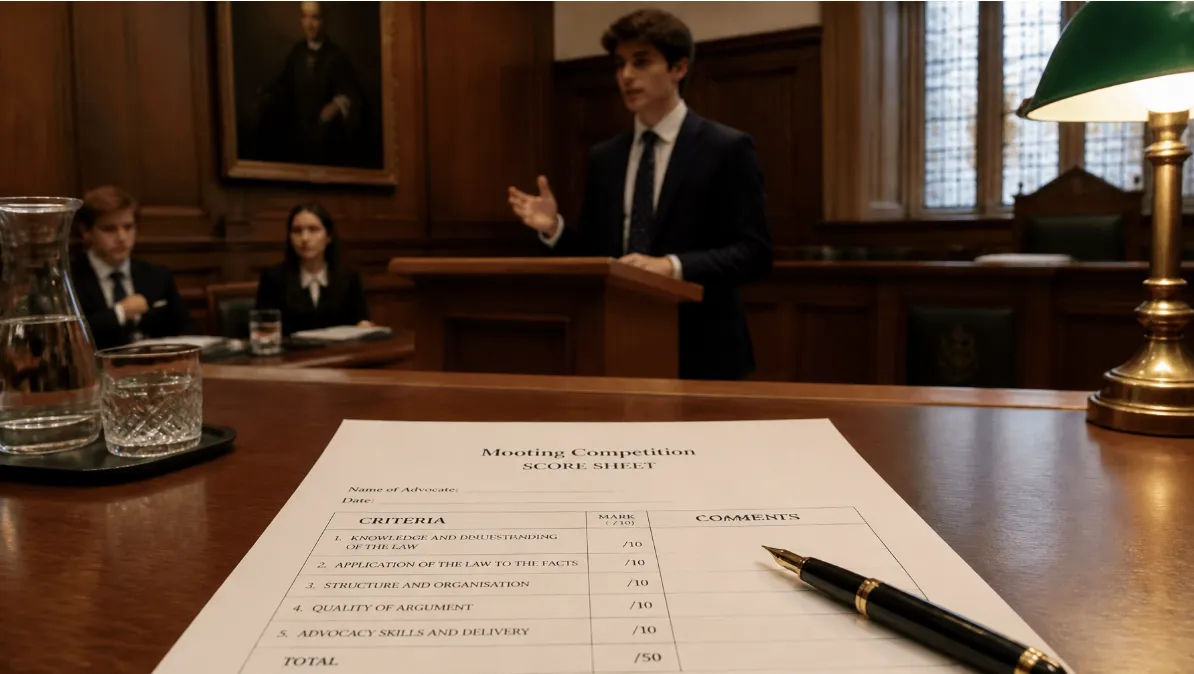
The Inside Scoop: What Mooting Judges Are Actually Putting on Their Score Sheets
Let’s be honest: standing at a lectern in front of a stone-faced barrister or judge is terrifying. You’ve spent weeks trekking through Westlaw, your skeleton argument is printed (and probably has one tiny typo you only noticed five minutes ago), and your heart is hammering against your ribs like it’s trying to escape.
But as you begin your submissions with a shaky, "May it please the court," have you ever wondered what’s actually happening on the other side of that mahogany bench? What is that judge scribbling while you’re mid-sentence? Is it a brilliant critique of your legal analysis, or are they just tallying how many times you’ve said "um"?
At Speed Mooting, we believe the best way to win is to understand the game. We’ve pulled back the curtain on our scoring criteria to show you exactly how you’re being measured. Whether you're preparing for a mooting competition or just trying to survive your first university moot, here is the "inside scoop" on some of the categories that decide your fate.
1. Courtroom Etiquette and Manner
The Vibe Check
Before you even open your mouth to argue the finer points of duty of care, the judge has already started marking this section. Etiquette isn't about being "posh", it’s about professional respect and creating the atmosphere of a real court.
Judges are looking for the "Three Ps": Punctuality, Politeness, and Presence. Are you addressing the bench correctly? In the UK when mooting, that’s "My Lord" or "My Lady." If you accidentally call them "Your Honour" when they’re sitting as a High Court judge, you might see a small frown.
2. Presentation and Clarity of Speech
Can We Actually Follow You?
You could have the most brilliant legal mind since Lord Denning, but if you’re mumbling into your notes at 200 miles per hour, the judge can’t give you the marks.
Judges are writing down things like: “Speaks too fast,” “Good eye contact,” or “Reads directly from the page.” Advocacy is a performance. You need to use your voice like an instrument, pause for emphasis, vary your tone, and for the love of all things legal, look up from your paper.
Mooting is advocacy, not academia. You aren't reciting a dissertation; you are trying to persuade a human being to agree with you. If the judge has to stop writing because they can't keep up with your speed, you're losing them.
Top tip from my experience: I used to think that "sounding like a lawyer" meant using long words and complex sentences. I was wrong. The best advocates speak in short, punchy sentences that a anyone can follow.
3. Ability to Develop Your Argument
The Meat of the Advocacy
This is where the marks are won or lost. A judge wants to see a logical flow. If your submissions feel like a random collection of thoughts, you’ll struggle to hit the mark.
Think of your argument like a map. You should tell the judge exactly where you’re going ("I have three submissions today, My Lord..."), tell them when you’ve arrived at a new location ("Turning now to my second submission..."), and remind them where you’ve been ("In light of those three points...").
Judges love "signposting." It makes their job easier. If they can easily follow your logic on their own notepad, they’re much more likely to give you a high score.
4. Use of Authority
Don’t Just Name-Drop
In a mooting competition, your authorities (cases and legislation) are your weapons. But there’s a difference between carrying a sword and knowing how to use it.
A judge isn’t impressed by a list of twenty cases. They are impressed when you take one case and show exactly why the principle within it means your client should win. Are you citing the correct law report? Are you giving the judge the right page number in the bundle?
Most importantly: do you actually know what happened in the case? There is nothing more dangerous than a judge asking, "And what were the facts in Donoghue v Stevenson, counsel?" and you having to admit you only read the headnote.
The lesson: It is better to rely on three cases you know inside out than ten cases you’ve only skimmed on Wikipedia.
5. Ability to Deal with Judge’s Interventions
The "Hot Seat"
This is the category that separates the novices from the pros. In a Mooting competition, like those we run at Speed Mooting the judge will interrupt you. They aren't doing it to be mean; they’re doing it to see how you think on your feet.
When a judge asks a question, you're probably panicking internally. But your external response should be a calm, "I am grateful for that question, My Lady."
Judges are looking for:
Did you listen to the question?
Did you answer it directly (Yes/No) before explaining?
Did you seamlessly transition back into your argument?
Another top tip from me: Never, ever talk over a judge. If their mouth opens, yours should close.
Deductions
Finally, we have the deductions. These are the "unforced errors" of the mooting world. Running over your time limit is the most common one. In our competitions, time management is a key advocacy skill. If you have five minutes and you spend four of them on your introduction, you’re in trouble.
Often, the difference between the winner and the runner-up is only one or two points. It usually comes down to who was more "malleable": the person who didn't just read a script, but actually engaged in a conversation with the bench.
How to Move from "Average" to "Advocate"
Understanding the score sheet is the first step. The second step is practice. You can read every blog post in the world, but advocacy is a muscle: it only gets stronger when you use it.
If you want to test these skills in a supportive, low-pressure environment, come and join us at the Legal Skills Academy. We’ve moved all our training and practice sessions there to create a one-stop-shop for aspiring lawyers. You’ll get to run through these exact criteria with your peers who will give you the real feedback you need to stand out in pupillage and training contract applications.
Don't wait for your first "real" moot to find out what's on the score sheet. Get the practice in now, make the mistakes here, and walk into the courtroom with the confidence of someone who already knows the ending.


