
Hidden Strengths: How Your Hobbies and Studies Are Prepping You for a Legal Career
We speak to hundreds of law students every year, and there is a recurring theme that breaks my heart just a little bit. It’s the "I’m just a..." syndrome.
"I’m just a shelf-stacker."
"I’m just a waitress."
"I just play Sunday League football"
Stop right there.
If you are waiting for a training contract or a pupillage to start "being a lawyer," you’re missing the goldmine you’re currently sitting on. The truth is, the skills required to navigate a difficult client in a Magic Circle firm are surprisingly similar to the skills required to tell a frustrated customer that, no, you cannot accept a return on a half-eaten sandwich.
Today, we’re going to stop downplaying your life. We’re going to look at the hidden strengths you’re building in your part-time jobs, your hobbies, and your daily studies, and most importantly, how to frame them so a recruiter actually takes notice.
1. The Retail Floor: Your Unofficial Courtroom
If you’ve worked in retail, you’ve essentially been in training for litigation and client care for years. You just didn’t have the wig and gown.
Think about the last time you had a customer complaining about a faulty product. You had to:
Listen actively without interrupting (Cross-examination 101).
De-escalate their anger so they didn’t cause a scene (Alternative Dispute Resolution).
Apply the rules of the store policy to their specific facts (Statutory Interpretation).
Reading the Room
In retail, you learn to read people. You know within ten seconds if a customer wants to be left alone or if they’re confused and need guidance. In law, this becomes rapport building. Whether you’re meeting a high-net-worth individual or a vulnerable client in a pro bono clinic, the ability to put someone at ease is your greatest asset.
The Art of Persuasion
You aren’t just "upselling" a protection plan or a pair of socks. You are identifying a need, addressing an objection, and presenting a solution. That is advocacy. When you’re in a moot, you’re doing the exact same thing: you’re persuading a judge that your "product" (your legal argument) is the best fit for the "customer" (the facts of the case).
2. Hospitality: High-Pressure Case Management
Working in a bar or restaurant is basically a lesson in high-stakes time management.
When you have five tables, three of them want the bill, one has a dietary requirement you need to check with the chef, and the barman just dropped a glass, that is priority management.
In a law firm, your "tables" are your cases. You’ll have competing deadlines, demanding partners, and unexpected emails that blow your schedule apart. If you can keep a cool head while a busy restaurant is screaming for service, you can handle a closing week on a multi-million pound deal.
The "Hidden" Skill: Attention to Detail
Did you get the order right? Did you remember that Table 4 asked for no onions? In law, a missed "no" or a misplaced comma can change the entire meaning of a contract. If you can thrive in the "check-back" culture of hospitality, you have the meticulous nature required for legal drafting.
3. Hobbies: Building the "Lawyer Muscle"
Recruiters don’t want robots. They want humans who can handle stress and work in a team. Your hobbies are the proof of your character.
Strategy Games and Puzzles
Are you a chess player? A logic puzzle fan? Or maybe you spend your weekends playing strategy-heavy video games. These aren't "time-wasters." They are training your brain for pattern recognition and anticipatory thinking.
Law is a game of "if/then." If the opponent argues X, then we respond with Y. Strategy games teach you to think three steps ahead, which is exactly what you need when drafting a witness statement or preparing for a mooting competition.
Team Sports
Whether it’s netball, football, or a rowing crew, team sports teach you accountability. If you don’t show up for training, the whole team suffers. In a law firm, you are part of a massive machine. Being the person who can be relied upon to "do their bit" is more valuable than being the smartest person in the room who refuses to collaborate.
Creative Writing and Journaling
If you write for fun, you are already ahead of the curve. Legal writing is about clarity and structure. Creative writing teaches you how to tell a story. Every case is a story: you just need to tell it using the law as your framework.
4. Turning Your Studies into Proof
Don't just list your modules on your CV. Everyone takes Tort. Everyone takes Contract. What did you do with them?
If you took part in a moot, you didn't just "participate." You:
Analysed complex legal bundles.
Conducted independent research under tight deadlines.
Responded to judicial intervention (which is basically a high-pressure Q&A).
If you’re looking to sharpen these specific skills in a low-pressure, supportive environment, you should check out our Legal Skills Academy. It’s where we take these raw "retail" skills and refine them into professional advocacy.
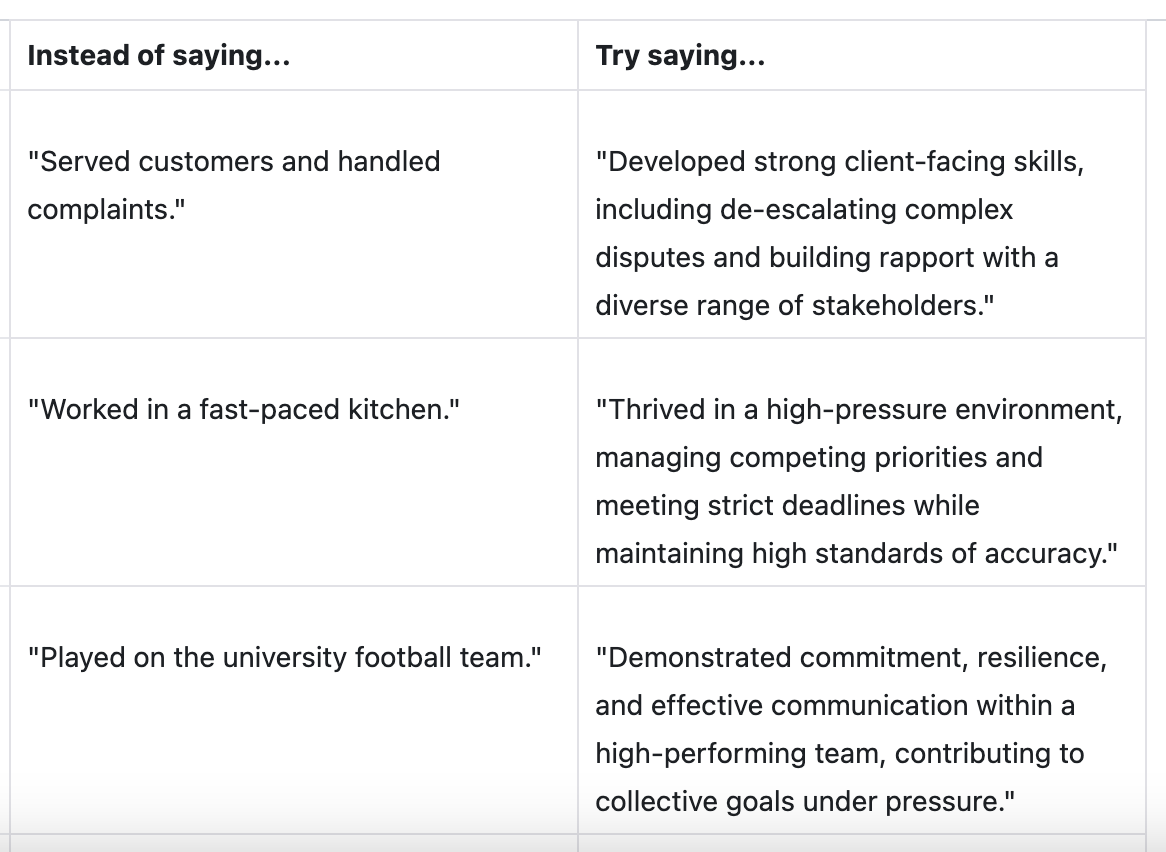
5. The "Translation Guide": From Shop Floor to CV
This is the part where most students struggle. How do you actually put this on paper? Here are some examples of translating your experience into "Lawyer-Speak."
6. Embracing the Learning Curve
It is okay to admit you don’t know everything yet. In fact, honesty is a transferable skill in itself: it's called integrity.
When you’re in an interview and they ask about a time you failed, don’t try to find a "fake" failure (like "I work too hard"). Tell them about the time you messed up an order or almost forgot a deadline in your studies, and then: this is the important bit: tell them exactly how you fixed it and what you did to make sure it never happened again.
That is the "Growth Mindset" that partners at top firms are looking for. They don't expect you to be a perfect lawyer on Day 1. They expect you to be a person who can learn, adapt, and keep going when things get tough.
7. Next Steps: Audit Yourself
Before you close this tab, I want you to do a quick exercise. Take a piece of paper and draw two columns.
Column A: Your daily tasks (Work, Hobbies, Uni life).
Column B: The legal skill it represents (Research, Persuasion, Resilience, Detail).
You’ll be surprised at how long that list gets.
You have the strengths. You have the experience. Now, it’s time to start showing it.


