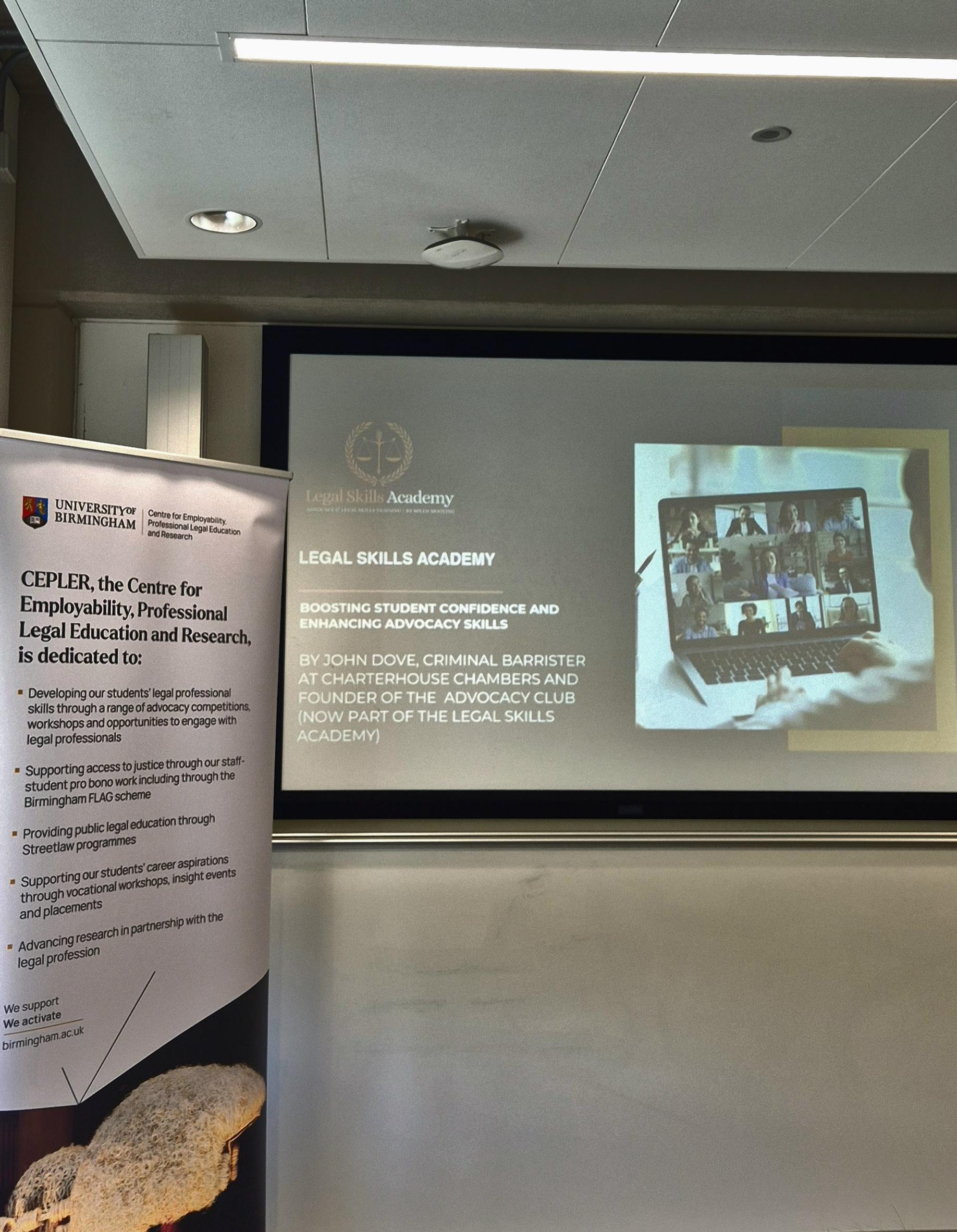
Lessons from the Birmingham Advocacy Workshop
I spent my Thursday at the University of Birmingham for an Advocacy Workshop hosted by the Birmingham Law School and the Centre for Employability, Professional Legal Education and Research (CEPLER). Walking into the Alan Walters Building, I expected to talk about cross-examination and skeleton arguments. What I didn't expect was a deep dive into how advocacy is, at its heart, a fundamental human skill for survival, activism, and connection.
If you think advocacy is just for barristers in wigs, you’re missing the bigger picture. Whether you are a law student, a medic, or someone fighting for a local cause, your ability to persuade is your most powerful tool.
Here are the key lessons I took away from a day spent with some of the brightest minds in legal education.
1. Advocacy as a Survival Skill
The day kicked off with an incredibly moving session from Dr Larysa Zhdankina from the University of Glasgow. She shared her experience teaching law in wartime Ukraine.
When your classroom is a bomb shelter, advocacy stops being an "exercise" and starts being an act of resilience. Larysa shared a formula that I think every aspiring lawyer should pin to their desk:
Arguments + Trust + Emotional Safety = Persuasion.
In turbulence, persuasion isn't about winning a point; it’s about restoring trust and providing safety. Larysa reminded us that a lawyer’s voice itself can be an act of advocacy: to lead, to comfort, and to reassure. It was a humbling reminder that while we often focus on the technicalities of a mooting competition, the true goal is to turn knowledge into care and conviction into action.
2. Taking Advocacy Beyond the Courtroom
Next, Dr Audrey Cook from the University of Birmingham challenged us to think about "civic advocacy."
Many students want to use their legal skills in alternative careers or for social activism. Audrey’s workshops show students how to turn a cold fact into a persuasive statement for an MP or a community group.
She discussed how emotion plays a vital role in teaching. We often tell law students to be "objective" and "detached," but Audrey argues that emotion fosters empathy and critical engagement. If you care about a cause, that passion is the fuel for your advocacy.
3. Building Confidence in a Low-Pressure Zone
Then it was my turn to take the floor. I spoke about my journey with the Advocacy Club, which is now a core part of our Legal Skills Academy.
Over the years, I’ve worked with thousands of junior and aspiring lawyers. The biggest barrier I see isn't a lack of intelligence; it’s a lack of confidence. The traditional way of teaching advocacy can be terrifying: lots of research, complex drafting, and then a "sink or swim" moment in front of a judge.
At the Legal Skills Academy, we do things differently. We focus on:
Low-pressure environments: Removing the need for weeks of research so you can focus on how you speak, not just what you say.
Peer-to-peer feedback: You learn as much from watching others and giving feedback as you do from speaking yourself.
Incremental gains: Whether it’s speed mooting or trial advocacy, you progress at your own pace.
I truly believe that advocacy is a craft. You wouldn't expect to play a piano concerto without practicing your scales first. We provide the "scales" so that when you get to the "concerto" (your first real case or big competition), you’re ready.
4. Drama: The Cure for Performance Anxiety?
One of the most fascinating sessions came from Professor Gianna Bouchard and Dr Mary S O’Hanlon. They’ve been using drama-based techniques to help Law and Medicine students manage performance anxiety.
Let’s be honest: standing up to speak is scary. Your heart races, your palms sweat, and your brain goes foggy. This is a physiological response, not a sign that you aren't "cut out" for the job.
By using drama practitioners, they teach students how to:
Manage the "physicality" of performance.
Control their breathing.
Navigate high-stakes situations like advocacy assessments or medical OSCEs.
It was a brilliant reminder that we are "performers" in the courtroom. Acknowledging the "performance" element helps take the sting out of the anxiety.
5. Language, Power, and the "Mooting Mold"
Theresa Lynch gave us a more critical, reflective look at mooting modules. She explored how class, power, and language function within legal education.
It’s an uncomfortable but necessary truth: the law has a "certain way" of speaking that can feel exclusionary. If you don't come from a background where that language is common, it can feel like you’re trying to fit into a mold that wasn't made for you.
Her research highlights that we need to be aware of these power relations to ensure that advocacy training is inclusive and doesn't just reward a specific "type" of student.
6. The "Case-Led" Model for Skills Progression
Finally, Nigel Booth from the University of Law (and co-author of the upcoming book The Skills of Modern Advocacy) talked about how we actually teach these skills.
Often, advocacy is taught in "bits." You learn cross-examination one week, then submissions the next. Nigel argued for a "case-led" model: using one fictional case that evolves over time.
This "spiral learning" approach allows students to see how their professional judgment needs to change as new evidence comes to light. It mirrors real life. In practice, you don't just "do a submission" in a vacuum; you do it based on everything that has happened in that specific case so far.
Bringing it All Together
So, what did a full day in Birmingham teach me?
Advocacy is a broad, beautiful, and vital skill. It’s about more than just knowing the law; it’s about the human connection between the speaker and the listener.
Whether you are navigating the "turbulence" of a personal crisis, fighting for civic change, or standing up in a mooting competition, the principles remain the same. You need trust, you need a case-led strategy, and you need the confidence to let your voice be heard.
If you’re feeling inspired to sharpen your own skills, come and join us at the Legal Skills Academy. We’ve taken everything we learned from the old Advocacy Club and supercharged it to help you become a well-rounded, confident advocate. No pressure, no judgment: just growth.
You can find out more here: https://speedmooting.com/legal-skills-academy


